May 19

Video: Raytrix demonstrates R29 LightField Features

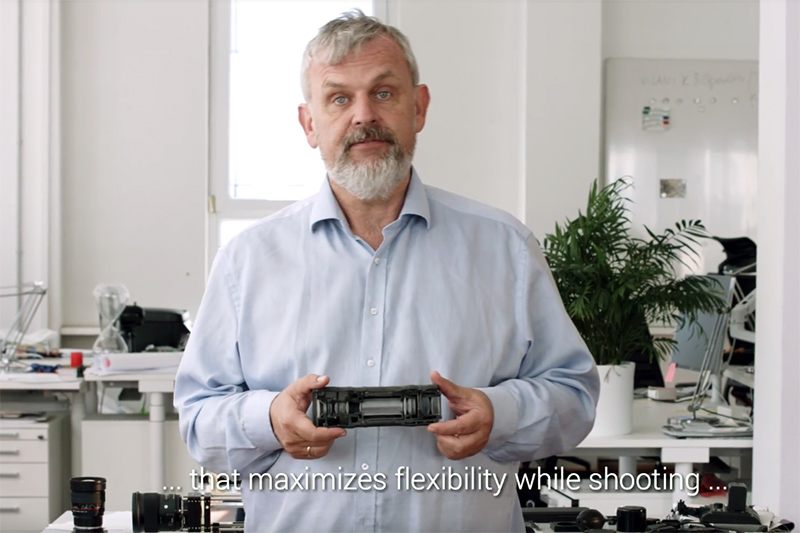
With their newest Youtube-Upload, German LightField specialist Raytrix demos the LightField features of their R29 camera.

The HD video includes original footage recorded with the high-end camera (resized from 3288 x 2192 = 7.2 megapixels; and 100 % crops), and demonstrates the reconstruction of 3D information – even at a subject-to-lens distance of 400 meters – as well as software refocus and extended depth of field.
Video frame rate for full-resolution imaging is 5 frames per second.

Screenshot: 3D reconstruction at long distances, using a Raytrix R29 LightField camera.

Continue reading

May 17

Lenticular Print Ad shows secret Message to Children

Lenticular prints are commonly used to create an illusion of movement or the impression of spatial depth, by selectively showing different images when seen from different angles. In the case of lenticular print postcards, posters etc., the distance between our eyes is enough to show a slightly different image to each eye, creating an illusion of depth.

Lenticular Print Ad shows secret Message to Children

Spain’s ANAR Foundation (Aid to Children and Adolescents at Risk) operates an anonymous and confidential help line for abused children. With their most recent poster campaign, they solved the problem of potentially abusive parents keeping their children from even looking at the ad that is set to help minors at risk. Continue reading

May 14

NOAA Looking to Dive into Light Field Imaging of Fish

NOAA Looking to Dive into Light Field Imaging of Fish LightField technology has a wide potential field of applications, which we’ve only recently begun to explore. One of these applications, which may soon be realized, is the 3D imaging of fish for scientific use:
The US National Oceanic and Atmospheric Administration (NOAA) has recently filed a statement of need notice for the development of an “underwater LightField camera system for single camera 3D imaging of fish” (WRAD-13-02577).
Looking at the specific camera requirements, it’s clear that the NOAA have a clear idea of what they want. At this stage, however, there’s no information about the precise application of the LightField pictures and video that the agency is hoping to record.

Details of the statement: Continue reading

May 09

Refocus: New App brings Software Refocus to Windows Phone 8

Refocus: New App brings Software Refocus to Windows Phone 8 The iPhone World has recently gained a cool new category of apps that bring refocus capabilities to your smartphone: tap2focus and FocusTwist, both released within a small timeframe, use the iPhone’s standard camera to take several pictures at different focus levels, and combine the individual frames into an interactive touch-to-refocus picture à la Lytro.

Now, Windows Phone 8 is the second platform to gain software refocus picture taking: The app, simply named Refocus (0.99 $) uses the same “image series” technique to record the necessary data, but unlike FocusTwist it’s not limited to square pictures Continue reading

May 06

Compressive LightField Photography enables Higher Resolution LightFields in a Single Image

Compressive LightField Photography enables Higher Resolution LightFields in a Single Image Today’s LightField technology uses either of two methods to record a LightField: it either reconstructs a single low-resolution LightField image (e.g. using microlens arrays or coded masks), or requires several individual pictures to be taken and combined for a high-resolution LightField (e.g. using camera gantries or coded apertures).
In a recent publication, Kshitij Marwah and colleagues introduced a new LightField camera prototype that combines the advantages of these two methods, to reconstruct higher-resolution LightFields from a single, coded image. To do so, they have co-designed the prototype camera to incorporate both of the main aspects of LightField technology: camera optics and computational processing.

Continue reading